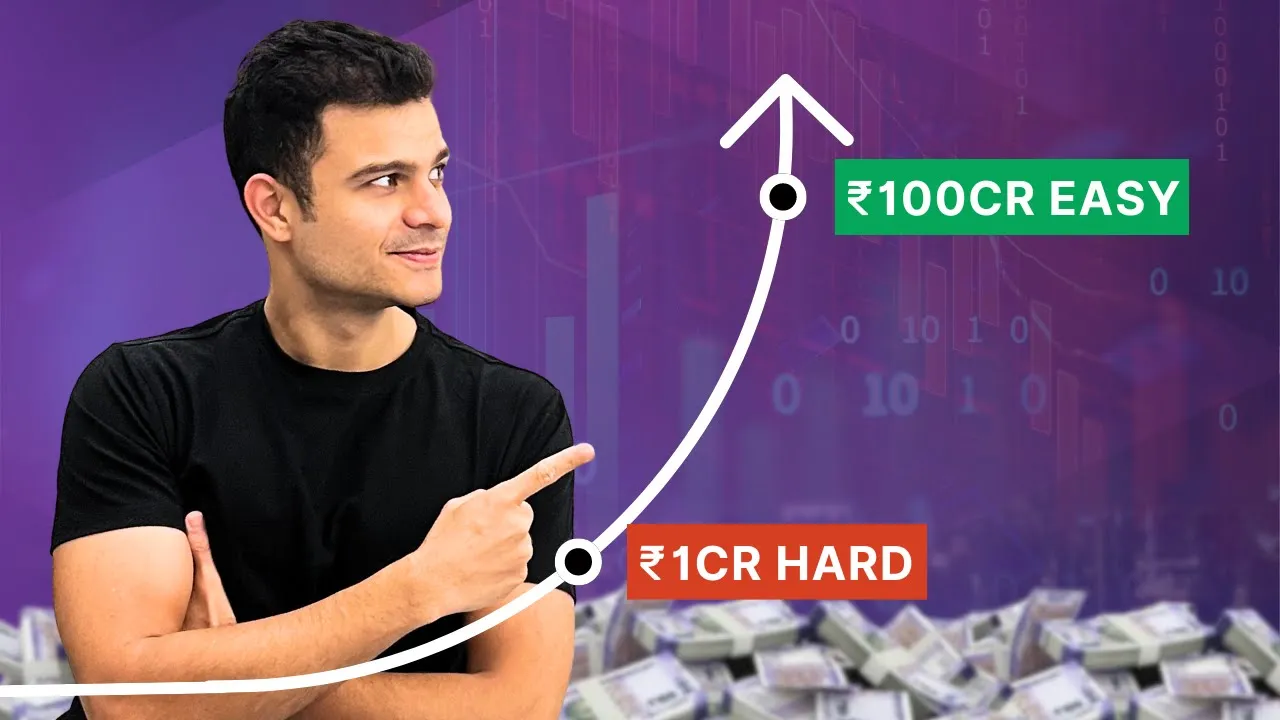
The first ₹1 crore can feel painfully slow.
You are building your income, controlling expenses and investing relatively small amounts. Market returns help, but they rarely feel transformative. Most of the progress still comes from your own effort.
Then something changes.
Once the invested corpus becomes large enough, the returns themselves start resembling an income. Your money is no longer merely supporting the journey. It becomes one of the main engines driving it.
That is why net worth can appear to “explode” after ₹1 crore. There is no magical threshold at exactly ₹1 crore, and growth is never guaranteed. But it is often around this scale that compounding becomes visible in rupee terms.
Table of Contents
Why ₹1 crore feels different
Consider a 12% annual return purely as an illustration:
| Invested amount | 12% annual return |
|---|---|
| ₹1 lakh | ₹12,000 |
| ₹10 lakh | ₹1.2 lakh |
| ₹1 crore | ₹12 lakh |
The percentage return is identical in every row. The experience is not.
A ₹12,000 annual gain is useful, but it will not materially change most lives. A ₹12 lakh gain can equal a meaningful part of a family’s annual expenses or a year of disciplined investing. The corpus has reached a point where one good year can add an amount that may previously have taken years to save.
This is the first reason wealth appears to accelerate: the same percentage acts on a much larger base.
Of course, markets do not deliver 12% neatly every year. A portfolio may rise sharply one year and fall the next. The example explains scale, not certainty.
Compounding means earning returns on previous returns
The second reason is compounding.
With simple interest, you earn a return only on the original capital. With compounding, the return is added to the capital, and future returns are earned on both.
If ₹1 crore compounds at 12% annually and you make no additional investment, it would grow to approximately ₹3.11 crore after ten years. The profit would be about ₹2.11 crore.
At a more conservative 10%, the same ₹1 crore would become approximately ₹2.59 crore. That difference is also a useful reminder: small changes in the assumed return create large differences over long periods.
| Starting corpus | After 10 years at 10% | After 10 years at 12% |
|---|---|---|
| ₹1 lakh | ₹2.59 lakh | ₹3.11 lakh |
| ₹10 lakh | ₹25.94 lakh | ₹31.06 lakh |
| ₹1 crore | ₹2.59 crore | ₹3.11 crore |
The multiplier is the same. What changes is the magnitude of the result.
Why every subsequent crore can arrive faster
Imagine ₹1 crore compounding at 12%, without adding or withdrawing any money.
- It crosses ₹2 crore around year seven.
- It crosses ₹3 crore around year ten.
- It crosses ₹4 crore around year thirteen.
- It crosses ₹5 crore around year fifteen.
The first additional crore takes roughly seven years. The next one takes about three. The following crore takes roughly another three, and the intervals continue to compress as the base becomes larger.
This does not happen because the investment suddenly becomes better. It happens because each year’s percentage return is being applied to an expanding corpus.
In real life, the journey will be uneven. There will be bear markets, stagnant periods, taxes, withdrawals and changes in asset allocation. Yet the underlying relationship remains: once the portfolio is large, investment returns can contribute more to annual wealth creation than fresh savings.
The first crore is still the hardest
The arithmetic after ₹1 crore is attractive. Reaching ₹1 crore is the part most people underestimate.
Before meaningful capital exists, there is very little for compounding to work with. Your primary wealth-building asset is not your portfolio. It is your ability to earn, save and consistently convert income into productive assets.
This is why investment optimisation is often overemphasised early in the journey. Someone investing ₹10,000 per month will usually benefit more from finding a sustainable way to invest ₹20,000 than from endlessly searching for a fund that might outperform by one percentage point.
In the accumulation stage, three levers matter:
- Increase your ability to create value.
- Keep a meaningful gap between income and expenses.
- Invest that gap consistently for a long time.
Investment returns matter, but they cannot compound money that was never invested.
How I built my first crore
My own path began with freelancing.
I focused first on developing a useful skill and connecting that skill to a business problem someone was willing to pay me to solve. The basic sequence was simple:
Skill → value → income → savings → investments
The pivotal step was creating a case study. A real result gave potential clients a reason to trust me and became more valuable than a list of qualifications.
I then moved from isolated projects toward monthly retainers. Projects have a fixed duration. A retainer creates recurring income by providing recurring value. That made income more predictable and allowed me to save and invest more deliberately.
Working with international clients increased the value of the same skill in a larger market. At the time, I illustrated three broad levels of retainers:
- ₹1.5 lakh per month, or ₹18 lakh annually
- ₹3 lakh per month, or ₹36 lakh annually
- ₹5 lakh per month, or ₹60 lakh annually
These were not promises or a universal roadmap. They showed how packaging a valuable service, proving its value and selling it in the right market could change the savings equation.
In my original plan, earning approximately ₹50 lakh a year while keeping annual expenses near ₹12 lakh created the possibility of saving around ₹38 lakh. Sustaining something close to that for several years made the first crore achievable.
The specific numbers will differ for everyone. The transferable lesson is that the first crore is usually built through human capital and disciplined saving. Later crores are increasingly supported by financial capital.
What changed after my first crore
At the time I recorded the original video, I modelled a plan using roughly ₹2.7 crore invested, ₹2 lakh in monthly contributions and a 15% average return. That projection produced dramatic future numbers.
I would not use 15% as a base-case planning assumption today. It may occur over certain periods, but building a life plan around it leaves too little room for valuation changes, poor return sequences and ordinary uncertainty.
The deeper lesson from that projection remains valid: once the corpus is large, the portfolio can do a growing share of the work. But the sensible response is not to chase higher returns. It is to avoid interrupting compounding.
The real work after ₹1 crore
Once wealth begins compounding meaningfully, the nature of the challenge changes.
Before ₹1 crore, the central question is often: How can I earn and invest more?
After ₹1 crore, another question becomes equally important: How do I avoid damaging a process that is already working?
The common dangers include:
- Chasing the fund or factor that performed best recently
- Taking concentrated bets because ordinary compounding feels boring
- Abandoning the plan during a market fall
- Increasing lifestyle expenses every time net worth rises
- Treating an optimistic return assumption as a guaranteed outcome
The goal is not to make the compounding curve look exciting every year. The goal is to remain invested through the years when it looks disappointing.
₹1 crore is a milestone, not financial freedom
It is also important not to fetishise the number.
₹1 crore does not automatically mean someone can retire. Its meaning depends on annual expenses, future obligations, asset allocation, taxes, inflation and the amount of uncertainty the person wants to absorb.
A household spending ₹4 lakh annually experiences ₹1 crore very differently from one spending ₹20 lakh. The corpus should therefore be interpreted in relation to the life it needs to support.
This is where expense tracking and the Enough Number become important. Wealth tells you what you have. Expenses help reveal what that wealth can sustainably support.
A more useful way to think about the journey
The path can be divided into three stages:
Stage 1: You do almost all the work
Income growth and savings dominate. Investment returns are small in absolute rupee terms.
Stage 2: You and your money work together
Annual returns begin to resemble your annual contributions. Consistency becomes visibly rewarding.
Stage 3: Your money can do more work than you
Portfolio movements may exceed what you can reasonably save in a year. Risk management, behaviour and patience become more important than optimisation.
This transition is gradual. It does not occur on the morning your account crosses ₹1 crore. But ₹1 crore is a useful psychological marker because the mathematics begins to feel real.
What to do if you are still building your first crore
- Invest in earning capacity. Build a skill that creates measurable value.
- Increase the savings gap. Focus on large recurring expenses and income growth before tiny optimisations.
- Use a simple portfolio. Complexity is not a prerequisite for compounding.
- Automate investing. Remove repeated decisions wherever possible.
- Avoid catastrophic mistakes. Excessive leverage, concentration and panic selling can erase years of disciplined work.
- Give the process time. Compounding looks unimpressive before it looks inevitable.
What to do after reaching ₹1 crore
- Continue investing if your income permits it.
- Use conservative return assumptions for life planning.
- Diversify instead of trying to force faster growth.
- Track annual expenses and future obligations.
- Rebalance periodically rather than reacting constantly.
- Protect your health, time and relationships alongside the portfolio.
The last point matters. Wealth is valuable because of the life it enables. Allowing the pursuit of the next crore to consume that life would defeat the purpose of building it.
The simple conclusion
The first crore is largely built by your work. The crores that follow are increasingly built by your money.
That is why net worth can accelerate after ₹1 crore:
- The same percentage return produces a larger rupee gain.
- Returns begin earning their own returns.
- Your existing corpus works alongside new contributions.
- Each subsequent milestone can require less time than the previous one.
But the most important lesson is not to race toward an arbitrary number. Build earning capacity, invest consistently, keep the portfolio simple and let time do work that effort alone cannot.
Disclaimer: This article is for education and documents my personal experience. Return illustrations are mathematical examples, not forecasts or investment advice. Actual returns can be lower or negative, and investment decisions should reflect your goals, risk capacity and circumstances.