In recent years, the Indian consumer market has undergone a significant behavioral shift. Driven by public health advocates and digital content creators, millions of buyers have finally learned to flip packages over, scanning for hidden palm oil, excessive refined sugar, and synthetic preservatives in industrial junk foods.
However, this hard-won skepticism possesses a massive blind spot: The Wellness Aisle.
When a product is positioned as a fitness supplement, encased in a sleek, laboratory-style tube, and endorsed by high-profile athletes, our critical thinking short-circuits.
This phenomenon is known as the Health Halo Effect. Consumers who rigorously interrogate a packet of potato chips will blindly drop a premium effervescent tablet into their water glass under the assumption that they are consuming pure, uncompromising health.
I’ve recently seen a lot of ‘Fast&Up Charge’ tablets across my friend’s and family’s health cabinets. I tried it out for myself and figured out it’s not exactly what it looks. And the same is true for many “healthy supplements”.
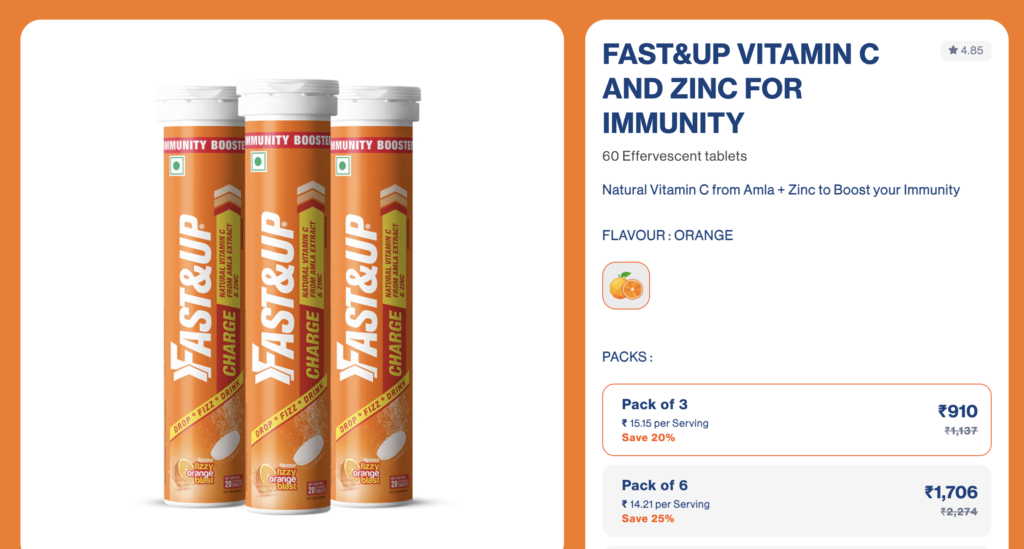
Using Fast&Up Charge as an example, I am writing this to reminder to always audit your health food with the exact same rigor you apply to your junk food.
Let’s take up a few points from Fast&Up Charge’s product:
Table of Contents
The Fast&Up Cost Breakdown (What You Are Actually Paying For)
A single tube of 20 tablets of Fast&Up Charge carries a standard Maximum Retail Price (MRP) of ₹390 to ₹425, though it frequently sells on quick-commerce platforms for around ₹320 to ₹350.
Cost Per Serving: This comes out to roughly ₹16 to ₹20 per tablet.
By comparison, a strip of standard 500 mg Vitamin C chewables (like Limcee or Celin) from any local Indian pharmacy costs roughly ₹1.50 to ₹2 per tablet.
When you pay a 10x premium for a product like this, you are not paying for the vitamins. You are paying for the chemical mechanism that turns a standard pill into a fizzy orange drink.
The Additives in Fast&Up: What Else is in the Tube?
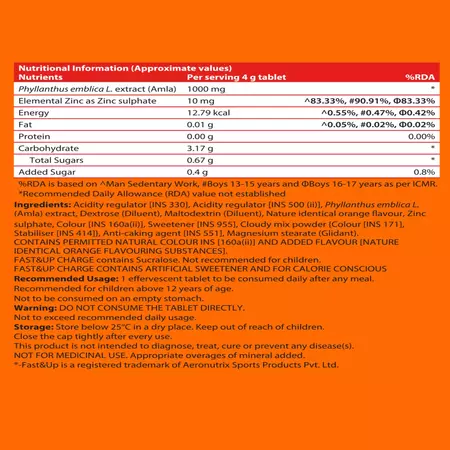
To take a tiny bit of zinc and a small dusting of Vitamin C and turn it into a stable, dissolvable, tasty drink, a heavy reliance on additives is required. A look at the back label reveals the precise additives used:
- Acidity Regulators (INS 330 & INS 500ii): Citric Acid and Sodium Bicarbonate (baking soda). These react when dropped into water to generate the “fizz.” This adds unnecessary sodium load to your daily intake.
- Bulking Agents & Fillers: Dextrose and Maltodextrin. These are fast-digesting sugars used to physically bulk out the tablet so it functions correctly.
- Artificial Sweeteners: Sucralose (INS 955). Used to mask the naturally bitter, metallic taste of synthetic vitamins and zinc without adding real sugar calories.
- Processing Aids (INS 551 & INS 470iii): Silicon Dioxide and Magnesium Stearate. Anti-caking and anti-sticking agents used purely so the machinery can press the powder into hard discs without gumming up the factory line.
- Synthetic Colors & Flavors: Inside the mix is Cloudy Mix Powder, Titanium Dioxide (INS 171), and nature-identical orange flavoring to give it that bright, opaque, soda-like appearance.
The Label Reality: A Highly Processed Effervescent Mix
Fast & Up is a synthetic delivery system where 90% of the tablet’s physical mass is composed of industrial acidity regulators, simple starches, chemical binders, and artificial sweeteners.
The Clean, Natural Alternative to Fast&Up
The ironies of “immunity supplements” are stark when looking at what can be obtained naturally, without any manufacturing byproducts or synthetic binders:
| Nutrient | Amount in 1 Tablet | Pure, Whole Food Source Equivalent |
| Vitamin C | ~50 mg (from 1000mg Amla Extract) | 1/2 of a single fresh Amla (Gooseberry) yields ~300mg of 100% bioavailable, natural Vitamin C. Alternatively, one orange or half a guava easily beats this tablet. |
| Zinc | 10 mg | A small handful of pumpkin seeds, a bowl of soaked chickpeas/lentils, or a serving of seafood covers this naturally alongside dietary fiber and healthy fats. |
The “1000 mg” Front-of-Pack Illusion
The primary marketing driver on the front of the Fast&Up Charge tube is a bold, eye-catching claim:
“1000 mg Natural Amla Extracted Vitamin C”
This shows up across their website and posters:
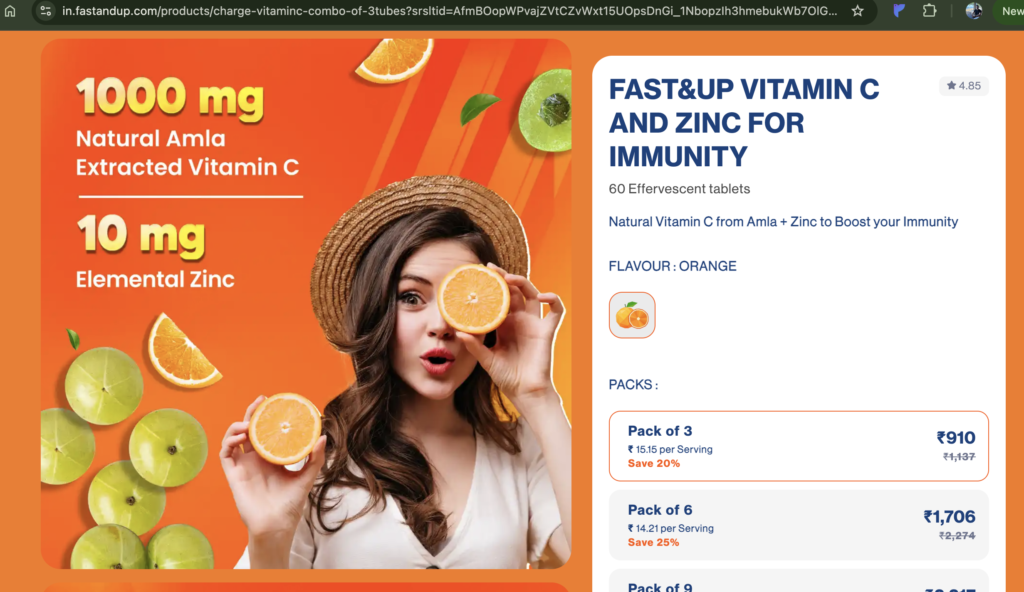
To a consumer scanning a shelf quickly, the cognitive takeaway is instantaneous: “I am purchasing a high-dose, 1000 mg Vitamin C supplement derived completely from real fruit.”
However, turning the tube around to inspect the fine print of the nutritional facts panel exposes a massive disconnect between marketing intent and chemical reality.
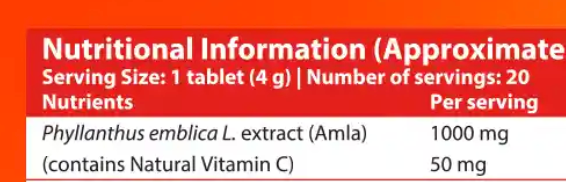
The label reads:
Nutritional Composition (Per Tablet):
- Phyllanthus emblica L. (Amla) Extract: 1000 mg
- Yielding Elemental Vitamin C: 50 mg
- Zinc Sulphate Monohydrate: 27.44 mg (Yielding Elemental Zinc: 10 mg)
The formulation reveals that the 1000 mg figure refers exclusively to the total weight of the raw, unstandardized amla extract powder, not the active vitamin itself. The actual, bioavailable yield of Vitamin C delivered to your body is a mere 50 mg per serving.
For perspective, the Recommended Dietary Allowance (RDA) for an adult in India hovers around 60–80 mg per day.
While 50 mg hits a basic baseline, it is far from the therapeutic, high-dose immunity booster promised by the front-of-pack presentation.
The Chemistry of the “Fizz”: Additives in the Tube of Fast & Up?
To turn a minor dose of micro-nutrients into a heavy, hard tablet that vigorously dissolves in water, the manufacturer cannot rely on fruit extract alone. Extract powder clumps, degrades in humidity, and tastes intensely bitter or metallic. Therefore, an extensive array of industrial chemical additives must be integrated to facilitate the product’s fizz:
Acidity Regulators & Carbonation Agents (INS 330 & INS 500ii)
The fizzy eruption that defines the product experience is caused by an acid-base reaction. When dropped into water, Citric Acid (INS 330) combines with Sodium Bicarbonate (INS 500ii) (common baking soda) to generate carbon dioxide gas.
While completely legal, this introduces a hidden, unnecessary load of dietary sodium into your routine, which is an important consideration for individuals monitoring blood pressure metrics.
Industrial Bulking Agents & Fast Carbs
To physically structure the tablet, manufacturers use Dextrose and Maltodextrin. Maltodextrin is a highly processed, high-glycemic powder derived from starch.
While used in tiny quantities per tablet here, it represents a completely empty, highly refined carbohydrate profile slipped into a premium health item.
Masking Agents & Sweeteners (INS 955)
Pure zinc and ascorbic acid possess an unpalatable, harsh metallic sting. To make the drink mimic a refreshing orange soda, the formula relies heavily on Sucralose (INS 955), an intense artificial sweetener, alongside proprietary “nature-identical” orange flavoring compounds and Cloudy Mix Powder.
Manufacturing & Anti-Caking Aids (INS 551 & INS 470iii)
To prevent the industrial compression machinery from gumming up or sticking during mass production, Silicon Dioxide and Magnesium Stearate are integrated as lubrication and anti-caking agents.
Additionally, Titanium Dioxide (INS 171) is utilized to ensure the final drink appears opaque and premium rather than unappealingly translucent.
The 10x Price Premium
When evaluated purely on a cost-to-nutrient metric, the financial premium charged for lifestyle effervescent formulations becomes highly apparent. Here is how it compares to standard pharmacy alternatives and whole foods:
| Product Metric | Fast&Up Charge (20 Tabs) | Standard Pharma Option (e.g., Limcee) | Whole Food Source (Fresh Amla) |
| Retail Market Price | ₹320 – ₹390 | ~₹15 – ₹20 (per strip) | ~₹10 – ₹20 (per 100g) |
| Cost Per Serving | ₹16.00 – ₹19.50 | ~₹1.50 | ~₹2.00 |
| Active Vitamin C Yield | 50 mg | 500 mg | ~300 mg (per fruit) |
| Price Multiplier Paid | 10x to 13x Premium | Baseline Cost | Fractional Cost |
| Accompanying Additives | Maltodextrin, Sucralose, Sodium Bicarbonate | Basic binders/chewable base | Fiber, polyphenols, bioflavonoids |
By buying the lifestyle option, the consumer pays roughly ten times more per serving than a medical-grade pharmacy equivalent, while receiving one-tenth of the active therapeutic dose. Effectively, the premium paid is not purchasing advanced health; it is funding marketing campaigns, localized quick-commerce logistics, and the industrial chemistry required to simulate a fizzy beverage experience.
The Clean Alternative & Conclusion
True, unadulterated health is rarely found inside an industrial tube. For individuals seeking authentic immune optimization and physiological recovery, the natural ecosystem provides vastly superior alternatives completely free of processed fillers:
- For Unmatched Vitamin C: Consuming half of a fresh Indian gooseberry (Amla) provides roughly 300 mg of fully bioavailable, active Vitamin C. It arrives natively bound to complex polyphenols and bioflavonoids that dramatically enhance how your cells absorb and utilize the nutrient. Alternatively, one whole local guava or an orange effortlessly satisfies the human body’s requirements.
- For Bioavailable Zinc: A small daily handful of raw pumpkin seeds, properly soaked lentils, chickpeas, or lean seasonal proteins naturally covers adult zinc requisites without adding artificial sweeteners or industrial processing aids to your liver’s metabolic workload.
Final Verdict: Fast&Up Charge is a classic example of lifestyle marketing expertly capturing consumer premium dollars.
It is not overtly toxic, but it is fundamentally unnecessary. If you struggle to swallow solid tablets, or require an absolute alternative to sugary sodas while traveling, it provides basic hydration utility.
However, for the conscious consumer practicing careful label analysis, it serves as a powerful reminder: Always audit your health food with the exact same rigor you apply to your junk food.